


An interview with James Wylie, the artist behind Lateral Lines at John Hansard Gallery
James Wylie grew up obsessed with the natural world. As a child in Wiltshire, he was lucky to be surrounded by nature. He also spent years dreaming of becoming a marine biologist. Now a photographer and artist, he’s based in Portsmouth and is about to show two art installations at Southampton’s John Hansard Gallery, Through the Eyes of Insects and Lateral Lines.
Lateral Lines is part of this year’s British Science Festival, which runs in Southampton from 16-20 September, organised by the British Science Association and hosted by the University of Southampton.
Ahead of the Festival, James spoke to the British Science Association about his career, practice, and what he hopes Festival visitors will take away with them from his interactive exhibition.
“I always wanted to be a marine biologist. It was mostly because I was really interested in sharks. I just love sharks, had an obsession with them since I was little,” James says. “Through school, I liked the science side, but was also very much interested in photography and ended up going all in on that.”
His aspirations shifted to photo-journalism, and becoming a “National Geographic kind of photographer”. “That was the dream,” he says. “It still kind of is, it’s never too late!”. He moved to Falmouth, Cornwall, and enrolled on a perfect degree programme – Marine and Natural History Photography. After three years he describes as “phenomenal” he ended up looking into something slightly different – what insects and flora look like under ultraviolet light.
It was a project he has continued for several years, which has changed his mindset and practice. “They have this thing called biofluorescence,” James explains. “Bioluminescence is when an animal or plant elicits a glow by itself, but biofluorescence only glows if you’re shining UV light on the subject. And biofluorescence is more common than you’d think it would be.”
James created lots of photographs using this method. “Seeing the insects glow, I’d ask more questions about it – why do they have this glow? Insects, as it turns out, have an innate ability to see into the UV light spectrum. They can see lights and colours we can’t see as human beings,” he says. This project became Through the Eyes of Insects, an opportunity to show humans how insects see the world.
It became an all-consuming project, but after a while he started to think bigger and wanted to look at other ways of ‘seeing’. The project had sparked a real intrigue about the senses. “As humans, our eyes tell us a lot about our environment. We’re visual creatures. But what about other ways of seeing, sensing, feeling? This led me to consider a few different scientific theories, focusing on conscious realism,” James says.
He read The Case Against Reality by Donald Hoffman and it has guided his practice since. “In short, our senses construct our reality. So everything that we see and smell and hear and taste, it’s all from us outward. Everything that we experience is because of our biological makeup.”
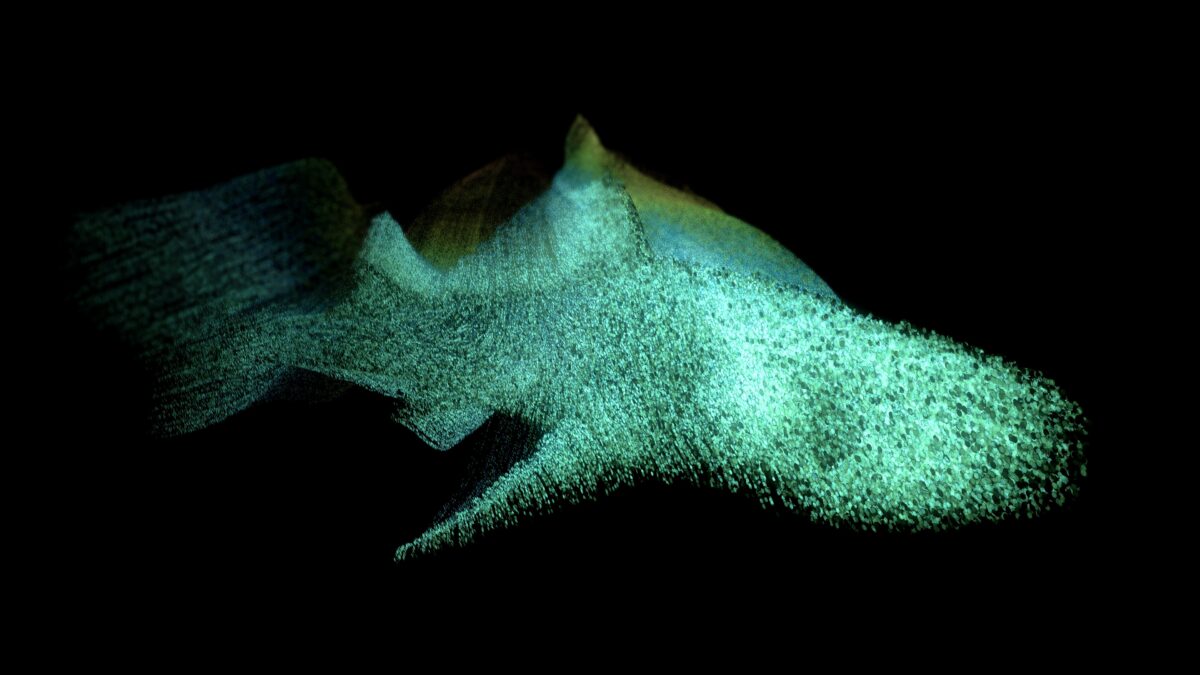
That idea of conscious realism is at the core of what he does now. It is applied to his photography and to other pieces of artwork – and that’s where we find Lateral Lines, an immersive installation where James invites you to step into the senses of a fish and explore how they perceive the world around them.
‘Lateral lines’ are what James describes as a sort of sixth sense – they are sensory organs that fish use to detect water and noise. It’s an unimaginable (for us) blend of sound and touch. Entering the space at John Hansard Gallery, you will be able to understand what it’s like for fish in Southampton dockyard in real time, as ships pass by, creating noise pollution that disrupts species and creates sensory stress.
“It’s a visualisation of a sense that isn’t visual at all. It becomes a way of understanding their reality. What’s interesting to me is that, we humans see certain colours, we hear certain sounds, and we smell specific scents. But I want to know, what’s beyond that? There’s one layer, but what could be beyond that? I want to interrogate that idea and explore it through the natural world.
Lateral Lines is a simulation because it could only be a simulation. The sea creatures’ experience is outside of our human reality and sensory abilities. It’s a translation which explores the unseen and the unfelt things.
“Lateral Lines focuses on noise – it is a huge part of it. I really wanted to add this layer of awareness about noise pollution. While you’re stepping into Lateral Lines, periodically you’ll notice the entire installation changes. The vibe feels bizarre and confusing. And it will then return to normal. The simulation is using live data to track when ships exit and enter Southampton docks. That live data triggers a visual and audio effect in the installation in real time.”
It is all about empathy and awareness raising about noise pollution: this simulation encourages us to empathise with the creatures that live in and around the docks and the Solent as a whole, how they experience that noise pollution with the lateral lines running down each side of their bodies.
“The word pollution is often given to a lot of things that affect us humans. Sewage, air pollution, things we can see or feel directly affecting us,” James says. “But there are many other kinds of pollution, including noise pollution, which we don’t pay much attention to because our senses don’t really allow it.”

Moving to Portsmouth – not too far from Southampton – has been life-changing for James. He has found an incredibly supportive creative community, full of brilliant, talented, people, and through Play Office – an incubator for young creatives – has had opportunities to upskill and develop new techniques in immersive technology and extended reality which are now major parts of his practice.
Lateral Lines moves away from photography. It is based on software and simulation. The forms of the underwater creatures are all digital, created from 3D models of spiny dogfish, an ungulate ray, a conga eel, bass and bream.
“I have photographed underwater before and I’d love to get back into that at some point,” James says. “I’m looking for an excuse to retrain! There’s such a feeling of freedom when you’re down there.”
James had heard a lot about John Hansard Gallery and thought it would be cool to exhibit there. “It’s been even cooler than expected, getting to know the people there has been absolutely fantastic. They’ve been immensely accommodating for someone who has had limited experience with gallery exhibiting before. It’s a wonderful thing to be welcomed like this and given the support I need to pull it all off.”
What’s next for him after this exhibition?
“Well, even after all these years, even after the marine photography course, I’ve still never actually had the chance to photograph a shark…”.
Lateral Lines by James Wylie will be at John Hansard Gallery’s Barker-Mill Gallery from Friday 18 – Sunday 20 September, as part of the British Science Festival. There’s no need to book, just turn up. All British Science Festival events are free.
John Hansard Gallery will also host other British Science Festival exhibitions and events in its spaces from 16-20 September, find out more on their website
Follow James on Instagram at @james.wylie.photography